ELECTRICAL ENGINEERING REFERENCE


ELECTRICITY AND MAGNETISM BASICS, CIRCUIT THEOREMS AND EQUATIONS


Electrical engineering

(EE) is a discipline that deals with electricity, magnetism and their applications. EE applications include electronics, power conversion, data communications, computer science, information technologies, and other. The term EE usually encompasses electronic engineering or electronics. Electronics involves the design and analysis of electronic circuits. In academia and electronic industry, the terms electrical and electronics engineer often are used interchangeably.
In other industries, the term electrical engineer may refer to those who deal with utility and industrial power systems and other electric equipment. In any case, both disciplines are overlapping.

The theoretical foundation for EE is electromagnetism. The theory of classical electromagnetism is based on Maxwell's equations (see below), which provide a unified description of the behavior of electric and magnetic fields as well as their interactions with matter. In practice however, circuit designers normally use simplified equations of electricity and magnetism and theorems that use circuit theory terms, such as Ohm's law modified for AC circuits, voltage and current Kirchoff's laws, and power relationships.

This webpage is for those who already learned EE and needs a quick reference. Here you will find electricity and magnetism basics, electronics reference as well as the career related information on the web.

Also see:
Electronic formulas and impedance calculations;
Understanding the physics of electronic circuits;
Distance learning, online degrees from accredited schools, salary surveys;
Engineering Jobs


Sponsored Ads


MAXWELL'S EQUATIONS IN FREE SPACE (in SI units)

LAW DIFFERENTIAL FORM INTEGRAL FORM
Gauss' law for electricity


Gauss' law for magnetism


Faraday's law of induction


Ampere's law

Maxwell equations
NOTES: E - electric field, ρ - charge density, ε0 ≈ 8.85×10⁻¹² - electric permittivity of free space, π ≈ 3.14159,
k - Boltzmann's constant, q - charge, B - magnetic induction, Φ - magnetic flux, J - current density, i - electric current,
c ≈ 299 792 458 m/s - the speed of light, µ0 = 4π×10-7 - magnetic permeability of free space, - del operator (if V is a vector function, then Del operator.V is divergence of V, Del operator×V is the curl of V).
BASIC ELECTRICAL THEOREMS AND CIRCUIT ANALYSIS LAWS

THE LAW DEFINITION RELATIONSHIP TO OTHER LAWS
Ohm's Law extended for AC circuits with single frequency sinusoidal signals V=Z×Ĩ, where V and Ĩ - voltage and current phasors, Z - complex impedance
(for resistive circuits: Z=R and V=R×I )
Lorentz force law and Drude model for resistors
Kirchhoff's Current Law (KCL) The sum of electric currents which flow into any junction in a circuit is equal to the sum of currents which flow out Conservation of electric charge
Kirchhoff's Voltage Law (KVL) The sum of the voltages around a closed circuit must be zero Conservation of energy
Note that Kirchhoff's laws can be derived from Maxwell's equations under static conditions, although historically they preceded Maxwell's equations.
You can download a reference sheet with the above equations in a pdf file.

ELECTRICAL NETWORK THEOREMS FOR AC CIRCUITS

THE THEOREM DEFINITION CALCULATION
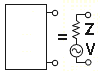
Thevenin's Theorem
Thevenin theorem
Any combination of a single frequency sinusoidal AC sources and impedances with two terminals can be replaced by a single voltage source V in series with an impedance Z. V - open-circuit voltage phasor of the original circuit;
Z - impedance between the two terminals with all voltage sources shorted and all current sources opened.
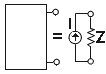
Norton's Theorem
Norton theorem
Any combination of a single frequency sinusoidal AC sources and impedances with two terminals A and B can be replaced by a single current source I in parallel with an impedance Z. I - short-circuit current phasor of the original circuit;
Z - impedance between the two terminals with all voltage sources shorted and all current sources opened.
Superposition Theorem The current (voltage) phasor in any part of a linear circuit equals the algebraic sum of the current (voltage) phasors produced by each source separately. To find an individual current (voltage) from each source, short all other voltage sources and open all other current sources.
Maximum Power Transfer Theorem A voltage source delivers maximum power to a adjustable when the source and the load impedances are complex conjugates of each other Active components of the source and load impedances should be equal, and reactive components should have equal magnitude but opposite sign.
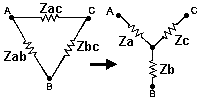
Delta to Wye Transformation
Delta to Wye diagram
A delta network of three impedances can be transformed into a star (Y) network of three impedances Za = ZcaZab / (Zab+Zbc+Zca)
Zb = ZabZbc / (Zab+Zbc+Zca)
Zc = ZbcZca / (Zab+Zbc+Zca)
Star-Delta Transformation
Star-delta transform diagram
A star (Y) network of three impedances can be transformed into a delta network of three impedances
Zab = Za + Zb + (ZaZb / Zc)
Zbc = Zb + Zc + (ZbZc / Za)
Zca = Zc + Za + (ZcZa / Zb)


ELECTRONICS REFERENCE

ELECTRICITY AND MAGNETISM ONLINE TEXTBOOKS, HANDBOOKS and COURSES

JOBS FOR ELECTRICAL ENGINEERS


Basic electrical engineering formulas and circuit calculations

Basic Electronics- free ebooks and online tutorials with simulations and troubleshooting

Electronic and safety standards

Electronic Components- online parts search and cross reference

Work, energy and power in electric field

Classical Electromagnetism relationships: Maxwell's equations, energy, relativity

Electricity and Magnetism, field and energy- free textbook and video course

Salary calculator by area and job category

Electronic engineer salary survey for 2009

Power supply design and other analog circuit design jobs


Google Custom Search
Web www.smps.us


Terms of Use

Privacy
© 2007, 2009 Lazar Rozenblat