RESIDENTIAL GRID TIE SOLAR SYSTEMS WITH BATTERY BACKUP

| Home |
| Solar energy |
| Solar homes |
| Inverter |
| PV systems |
| Off grid |
| Grid tied |
| Grid tie backup |
| PV panels |
| PV cells |
| Cost |
| Pros and Cons |
| Efficiency |
| Lighting |
| Sinewave inverters |
THE OPERATION BASICS
The grid tie solar systems with battery backup are similar to batteryless systems, except they can additionally provide electricity in case of a utility power failure while sunshine is absent or not sufficient.
Here is how such systems work. When sun is shining, the solar panels generate power, which reduces the consumption of electricity from the grid and cuts electric bills accordingly. If this power is not enough for your home, the required balance is automatically provided by the utility. If the system generates more electricity than your house is using, it will feed the excess back to the grid. When you feed power back to grid it can spin your electric meter backward. Of course, you would need a special grid-tie inverter that can work in parallel with the grid. Under normal conditions, a small portion of the energy is also used to keep the storage batteries charged.
When the utility power fails and sunlight is not sufficient, the battery can power the house or selected loads for some period of time. Contrary to common misconception, most conventional solar systems advertised everywhere are batteryless. They do not provide any backup. An obvious advantage of a PV-based generator's backup is it may provide a certain protection against short-term blackouts. Its disadvantages are obviously larger up-front investment relative to a batteryless system and lower reliability due to the limited lifetime of the batteries. By the way, if "wet" batteries are selected, they need to be periodically checked for fluids. Sealed batteries do not need any maintenance but may not last as long as the wet types. For a comparison, a typical warranty for solar panels is 20-25 years, inverters- 3-10 years, batteries 1-3 years. After some 25 years the panels characteristics significantly degraded.
SOLAR PANEL WIRING AND PRINCIPLES OF OPERATION
This simplified solar panel wiring diagram illustrates the system's operation.
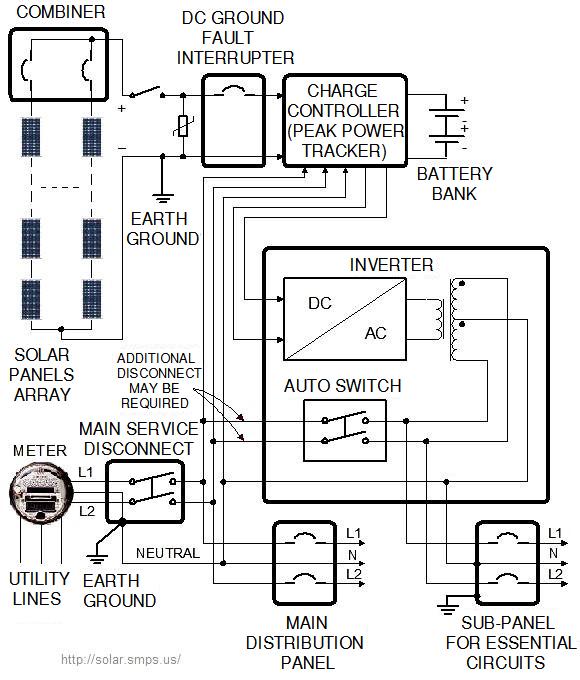
Note that "earth ground" for the DC circuit have to be provided in a single point. A DC ground fault interrupter disconnects the DC input when a certain leakage current from the ungrounded bus is detected.
The storage batteries should never be connected directly to solar arrays since it may result in frequent overcharging that reduces useful life of the batteries and can cause their damage. Also, with a direct connection, the battery will determine the voltage level at which the solar array will operate. This level most likely will not correspond to the peak power point of the cells (see characteristics of PV panels).
In practice, a grid-interactive inverter for the systems with battery backup usually includes a DC ground fault interrupter, DC-AC inverter itself and a charger all in one package. It often also has several pairs of fused DC inputs, which can eliminate the need for an external combiner. For the basic principals of its operation see grid tie inverter fundamentals.
The above schematic diagram shows an example of a wiring configuration when the inverter has a low-frequency center-tapped output transformer for 120/240 VAC. Often a low-power residential-grade inverter provides only 120VAC. In this case, if your house wiring is 120/240V, you would need special "stackable" modules. You will need to stack in series two 120V modules to get 120/240 output. Note that some models provide isolation in a high-frequency DC-DC converter stage and do not have a bulky low-frequency transformer. There are also transformerless models which require ungrounded DC busses and additional protection devices.
The above system allows excess electricity that is generated by solar panels to be exported to the grid. Under normal conditions, the grid acts as an additional energy source to keep the system's batteries charged. If the grid fails, the inverter will automatically disconnects from the grid and supplies energy from the batteries to the critical loads wired to an auxiliary panel. UL1741 standard requires a grid-tie inverter to disconnect from the grid within 0.1 second when input voltage goes off or drops below 60 VAC. When the line voltage returns, an internal AC contactor will automatically transfer the wiring system back to the utility.
Note that in general, NEC® 2023 codes allow PV array voltages all the way up to 600VDC. However, if the battery connections are above 60V, you need to make sure that "live" conductors are not accessible.